


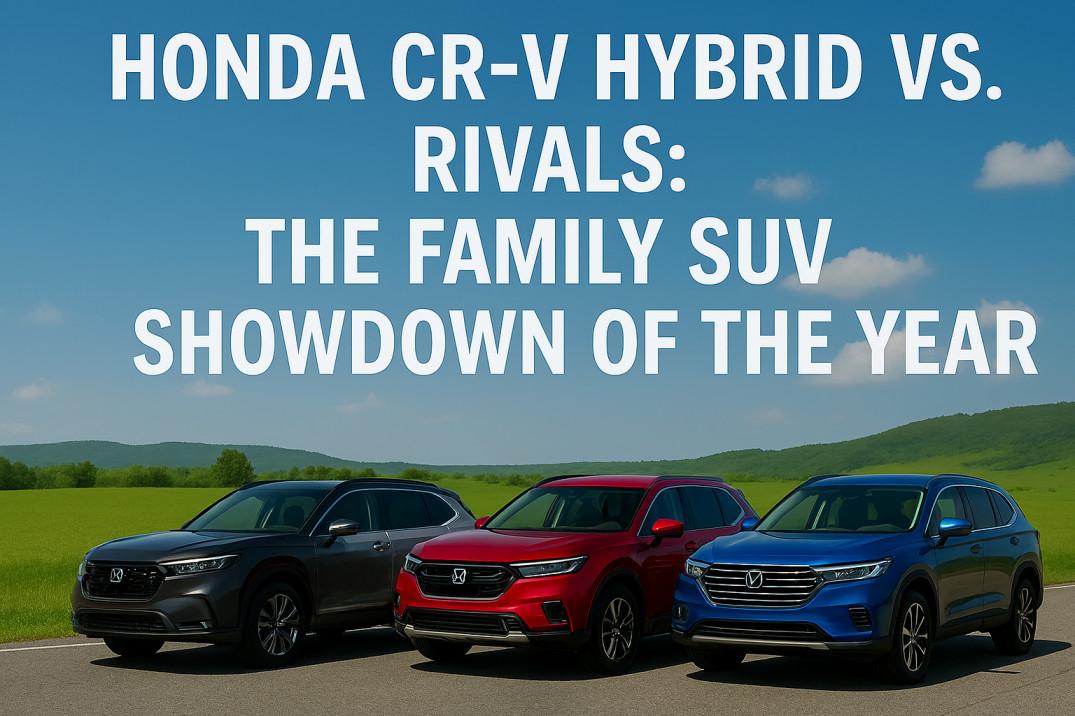
Honda CR-V Hybrid vs. Rivals: The Family SUV Showdown of the Year
Introduction
The compact SUV market in 2025 is experiencing a seismic shift toward hybrid powertrains, and the Honda CR-V Hybrid stands at the center of this revolution. For families seeking the perfect balance of space, efficiency, reliability, and modern technology, this year's competition is fiercer than ever. The 2025 Honda CR-V Hybrid competes directly with formidable rivals like the Toyota RAV4 Hybrid, Mazda CX-5, Ford Escape Hybrid, and an expanding roster of electrified crossovers that promise to transform the American family vehicle landscape.
This comprehensive guide dissects the Honda CR-V Hybrid against its primary competitors, examining fuel economy, performance metrics, pricing, interior comfort, cargo capacity, safety technology, and real-world ownership costs. Whether you're a budget-conscious parent, an eco-conscious driver, or someone seeking cutting-edge automotive innovation, this comparison will help you make an informed purchasing decision.
The Honda CR-V Hybrid: A Compact SUV Reimagined
The 2025 Honda CR-V Hybrid represents Honda's commitment to delivering practical family transportation without sacrificing efficiency or driving enjoyment. This turbocharged hybrid powertrain marks a significant evolution from traditional CR-V offerings, merging a 2.0-liter Atkinson-cycle engine with dual electric motors and a sophisticated CVT transmission.
Powertrain and Performance
Honda engineered the CR-V Hybrid's powertrain to deliver 204 combined horsepower and impressive torque delivery characteristic of hybrid systems. The 1.1-kWh lithium-ion battery pack seamlessly switches between gas and electric operation, optimizing efficiency across diverse driving conditions. Real-world testing confirms the CR-V Hybrid achieves 43 city / 36 highway / 40 combined MPG, translating to approximately $85 monthly fuel costs—a compelling advantage for families covering 12,000 to 15,000 miles annually.
Pricing and Trim Structure
The 2025 Honda CR-V Hybrid is strategically positioned in the mid-market segment with aggressive pricing designed to capture cost-conscious buyers:
| Trim Level | Starting Price | Drivetrain |
|---|---|---|
| Sport | $36,045 | Front-Wheel Drive |
| Sport-L | $39,045 | Front-Wheel Drive |
| Sport Touring | $42,495 | All-Wheel Drive Standard |
A $1,500 all-wheel drive upgrade is available for Sport and Sport-L trims, making the CR-V Hybrid accessible to a broader demographic while maintaining Honda's reputation for value proposition. These base prices include the $1,395 destination fee standard across the lineup.
Interior Design and Technology
Honda prioritized innovative interior design and comprehensive safety features throughout the CR-V Hybrid range. The cabin incorporates soft-touch materials, an intuitive infotainment system, and spacious seating for five passengers across two rows. Cargo capacity of 36.3 cubic feet provides adequate space for families navigating school runs, weekend adventures, and grocery shopping—though not class-leading by modern standards.
Toyota RAV4 Hybrid: The Reliability Juggernaut
The Toyota RAV4 Hybrid has dominated the compact hybrid SUV category for nearly two decades, and 2025 marks no exception to this trend. Toyota's unwavering focus on reliability, fuel efficiency, and comprehensive safety technology has established the RAV4 Hybrid as the segment's reliability benchmark—a position that influences purchasing decisions across demographic segments.
Powertrain and Real-World Efficiency
The 2025 Toyota RAV4 Hybrid features a 2.5-liter engine paired with dual electric motors, collectively producing 219 horsepower. EPA ratings confirm 40 MPG combined fuel economy, matching the CR-V Hybrid's efficiency metrics. The RAV4 Hybrid's larger displacement engine delivers additional torque, providing perceptible performance advantages during highway merging and moderate acceleration scenarios. For families prioritizing fuel efficiency, Toyota's dual electric motor configuration represents redundancy—if one motor fails, the vehicle maintains hybrid operation, a technological safeguard absent in single-motor competitors.
Cargo Space Dominance
Where the RAV4 Hybrid distinctly separates from competitors is maximum cargo versatility. With 69.8 cubic feet of maximum cargo space (rear seats folded) versus the CR-V Hybrid's lower capacity, the RAV4 accommodates larger loads, sports equipment, and recreational gear that exceed CR-V dimensions. The 37.5 cubic feet behind the second row provides genuine flexibility for active families managing multiple children's activities, camping equipment, and regular shopping runs.
Pricing Strategy
Toyota's RAV4 Hybrid pricing follows the company's market leadership positioning, typically commanding a modest premium over direct competitors. 2025 RAV4 Hybrid pricing ranges from approximately $32,000 for base models to $45,000+ for premium configurations—reflecting Toyota's brand equity and proven reliability track record.
Hybrid Technology Advantages
Toyota's i-Force MAX hybrid system has undergone continuous refinement, delivering smooth power transitions between gas and electric operation. The dual electric motor configuration provides performance redundancy and enhanced regenerative braking efficiency, maximizing fuel economy in urban driving scenarios where stop-and-go patterns dominate.
Mazda CX-5: Premium Design Meets Everyday Practicality
The Mazda CX-5 occupies a distinct market position, emphasizing premium interior materials, superior handling characteristics, and design sophistication that appeals to drivers seeking automotive pleasure alongside practical transportation. While Mazda has not yet introduced a hybrid variant of the CX-5, the non-hybrid model's performance profile and feature set merit serious consideration within the compact SUV ecosystem.
Engine and Performance Characteristics
The 2025 Mazda CX-5 operates a 2.5-liter four-cylinder engine producing 187 horsepower and 186 lb-ft of torque, modest specifications relative to direct competitors. However, Mazda's Skyactiv engine technology prioritizes responsiveness and driving engagement, delivering a driving experience that transcends raw horsepower metrics.
Interior Sophistication and Comfort
Mazda CX-5 trims feature upscale interior appointments, standard leather seating, and a larger 10.3-inch infotainment display that creates a premium cabin experience exceeding Honda and Toyota offerings in this segment. For drivers who spend considerable time within the cabin and value tactile quality alongside technology integration, the CX-5 delivers measurable satisfaction advantages.
Cargo and Towing Capabilities
The CX-5 provides maximum towing capacity of 2,000 pounds—a 33 percent advantage over the RAV4's 1,500-pound rating, positioning the CX-5 as the choice for active families who regularly haul recreational trailers, small boats, or utility equipment. This distinction addresses a common pain point for families who discover vehicle limitations only after purchase.
Fuel Economy Trade-offs
At 26/30 MPG (City/Highway), the CX-5's fuel economy trails hybrid alternatives by significant margins. For drivers prioritizing driving dynamics and interior premium quality over fuel efficiency, the CX-5 presents an acceptable compromise. However, families calculating lifetime ownership costs will gravitate toward hybrid alternatives offering superior long-term fuel savings.
Ford Escape Hybrid: Agile Performance and Technology Integration
The 2025 Ford Escape Hybrid merges agile urban performance with innovative safety technology and contemporary design language. Ford's approach emphasizes nimble handling and intuitive technology integration, appealing to tech-forward drivers valuing seamless smartphone connectivity and advanced driver assistance systems.
Powertrain and Efficiency
The Ford Escape Hybrid delivers 200 horsepower with 41 MPG combined fuel economy, positioning it competitively within the hybrid compact SUV segment. The Escape's slightly lower horsepower relative to CR-V and RAV4 hybrids reflects Ford's optimization strategy prioritizing efficiency over performance dominance.
Technology and Infotainment
Ford's SYNC infotainment system integration and wireless smartphone connectivity features appeal to families prioritizing seamless technology integration with mobile devices. The Escape's spacious cabin and intuitive control layout facilitate quick technology adaptation, reducing learning curves compared to competitors introducing novel interface paradigms.
Pricing Positioning
The 2025 Ford Escape Hybrid's pricing aligns with mainstream market positioning, typically competitive with Honda CR-V Hybrid base models while offering differentiated technology features that appeal to digitally-native families.
Hyundai Tucson Hybrid and Kia Sportage Hybrid: Value-Oriented Alternatives
The Korean automotive manufacturers have aggressively pursued the compact hybrid SUV segment with competitive pricing, extended warranty programs, and cutting-edge design language. Both the 2025 Hyundai Tucson Hybrid and Kia Sportage Hybrid present compelling alternatives for budget-conscious families.
Hyundai Tucson Hybrid: Design Innovation and Warranty Coverage
Hyundai's Tucson Hybrid features eye-catching design differentiation, 35–38 MPG combined efficiency, and critically, a 10-year/100,000-mile powertrain warranty—substantially exceeding Honda and Toyota's traditional warranty offerings. This extended coverage provides tangible peace-of-mind advantages for families retaining vehicles beyond seven-year timeframes.
The 2025 Hyundai Tucson Plug-In Hybrid variant introduces 33 miles of all-electric range via a 13.8-kWh battery pack, addressing families willing to accept higher upfront costs ($41,675 starting) for enhanced electric-only capabilities during routine commutes.
Kia Sportage Hybrid: Redesigned Excellence
The Kia Sportage Hybrid achieves best-in-class 43 MPG combined fuel economy, matching or exceeding traditional hybrid competitors. Redesigned digital displays, seamless smartphone integration, and a turbocharged 1.6-liter engine paired with electric motors combine to deliver 226 horsepower, providing spirited acceleration characteristics appreciated by families valuing driving engagement.
| Model | Combined MPG | Horsepower | Starting Price | Warranty |
|---|---|---|---|---|
| Honda CR-V Hybrid | 40 | 204 | $36,045 | 3 yr/36k |
| Toyota RAV4 Hybrid | 40 | 219 | ~$32,000 | 3 yr/36k |
| Mazda CX-5 (Non-Hybrid) | 28 | 187 | ~$28,000 | 3 yr/36k |
| Ford Escape Hybrid | 41 | 200 | ~$35,000 | 3 yr/36k |
| Hyundai Tucson Hybrid | 35–38 | ~210 | $33,800 | 10 yr/100k |
| Kia Sportage Hybrid | 43 | 226 | ~$32,500 | 10 yr/100k |
Comprehensive Feature Comparison: Safety, Interior Space, and Cargo Versatility
Safety Technology and Driver Assistance Systems
Modern family SUVs increasingly differentiate on advanced safety technology suites. Toyota's Safety Sense 2.5 platform offers enhanced pedestrian detection and road sign recognition capabilities, while Honda's Honda Sensing provides comparable functionality across core metrics. Both systems employ adaptive cruise control, lane-keeping assist, and forward collision mitigation—table-stake features across the segment.
Hyundai and Kia's warranty leadership extends to safety features, with extended coverage providing additional confidence for families prioritizing long-term reliability and accident mitigation technology.
Interior Space and Passenger Comfort
All competitive models accommodate five passengers comfortably across two rows. The RAV4 Hybrid's 60/40 rear-seat configuration limits flexibility, while the Mazda CX-5's 40/20/40 split-fold design enables superior cargo/passenger combinations. The Honda CR-V Hybrid's adaptive seating positions it mid-range for versatility, appealing to families balancing passenger comfort with occasional cargo expansion.
Real-World Ownership Costs and Long-Term Value
For families calculating ownership costs across five-to-ten-year horizons, hybrid fuel efficiency translates to tangible savings. A family driving 12,000 miles annually realizes approximately $1,020 annual fuel cost savings (CR-V Hybrid at $3/gallon regular unleaded versus comparable non-hybrid CX-5). Over a seven-year ownership period, accumulated fuel savings exceed $7,000—justifying hybrid powertrain premiums ranging from $3,000 to $8,000.
Honda CR-V Hybrid vs. Toyota RAV4 Hybrid: The Direct Rivalry
The Honda CR-V Hybrid and Toyota RAV4 Hybrid represent the segment's apex competitors, splitting owner loyalty based on individual priorities rather than objective superiority. Both deliver 40 MPG combined efficiency, compelling reliability records, and comprehensive technology integration.
Honda's Advantages: The CR-V Hybrid offers lower starting prices ($36,045 versus ~$32,000 for RAV4, though RAV4 gas models start lower), innovative interior design, and responsive handling characteristics that appeal to drivers valuing driving engagement.
Toyota's Advantages: The RAV4 Hybrid commands larger cargo capacity (69.8 versus 36.3 cubic feet), dual electric motor redundancy, and an unmatched reliability reputation spanning two decades. Resale values for RAV4 Hybrids historically exceed CR-V counterparts by 3-5 percentage points.
Why Family Buyers Are Choosing Hybrids in 2025
The hybrid SUV segment's explosive growth reflects converging market forces: volatile fuel pricing, intensifying environmental consciousness, and genuine technological maturity rendering hybrid drivetrains reliable and economically justifiable. Families operating SUVs for transportation rather than performance increasingly recognize that hybrid efficiency delivers quantifiable annual savings without sacrificing interior space or seating capacity.
Federal tax incentives, state-level EV credits (applicable to plug-in variants), and corporate sustainability initiatives further accelerate hybrid adoption. For families evaluating vehicle ownership across long-term horizons, hybrid powertrains represent rational economic decisions buttressed by environmental benefits.
Conclusion and Recommendations
The 2025 Honda CR-V Hybrid merits serious consideration for families prioritizing value, interior innovation, and reliable everyday transportation. Competitive base pricing, intuitive technology integration, and adequate cargo capacity position the CR-V Hybrid as an exceptional entry point into family-oriented hybrid SUVs.
However, families with maximum cargo requirements, prioritizing legendary reliability, and retaining vehicles beyond seven-year timeframes should contemplate the Toyota RAV4 Hybrid's superior cargo space and proven resale value retention. The RAV4's dual electric motor configuration and two-decade reliability track record justify modest upfront investment premiums.
For design-conscious drivers valuing premium interior materials, the Mazda CX-5 remains competitive despite lacking hybrid powertrain options. Budget-conscious families intrigued by extended warranty coverage should evaluate Korean manufacturer alternatives—Hyundai Tucson Hybrid and Kia Sportage Hybrid represent exceptional value propositions supported by industry-leading coverage.
Ultimately, 2025's family SUV competition reflects automotive market democratization: multiple manufacturers deliver competent, efficient, reliable transportation across diverse price points and feature sets. The optimal choice depends on personal priorities, budget constraints, and ownership intentions rather than objective superiority.

 English
 Arabic
 French
 Spanish
 Portuguese
 Turkish
 Dutch
Dutch
 Italiano
 Russian
 Romaian
 Portuguese (Brazil)
 Greek
Greek
